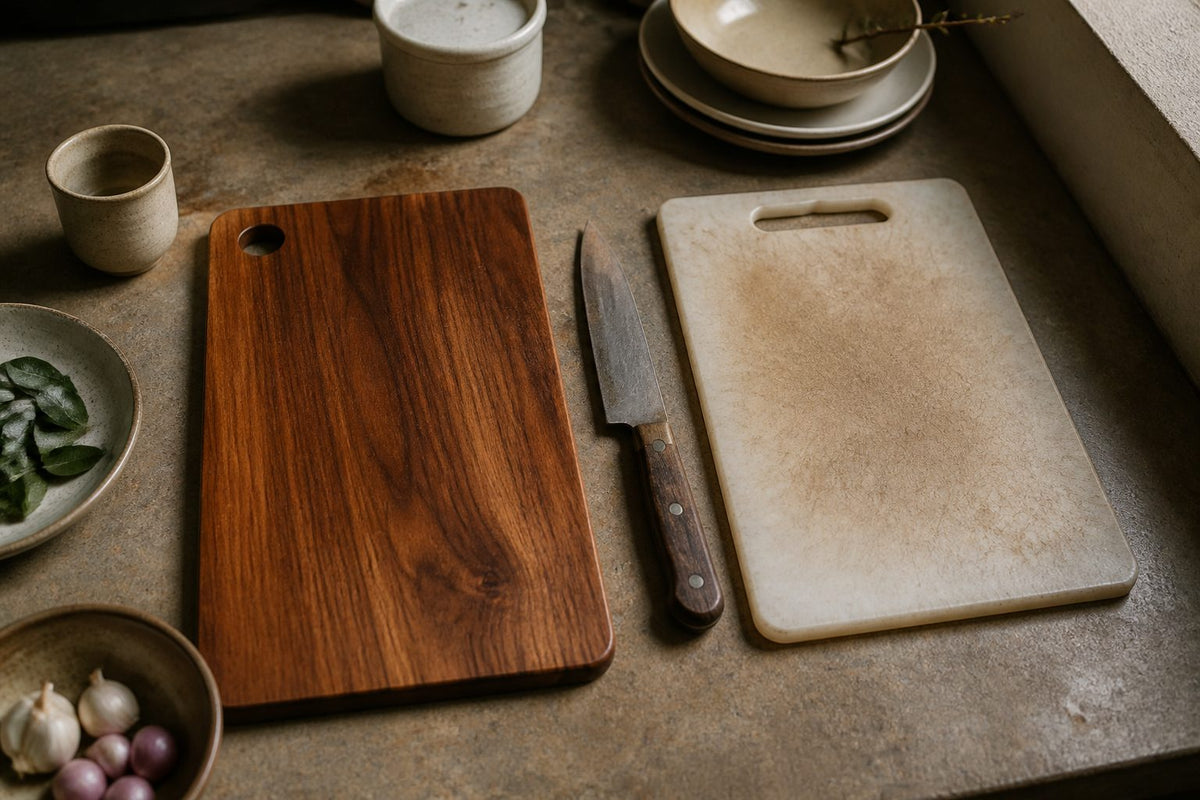
A wooden board will outlast almost anything else in your kitchen, or it will split down the middle inside a year. The difference is not the wood. It is what happens in the ten minutes after you finish using it.
The one mistake that ruins most boards
Leaving it wet.
Not washing it, leaving it wet. A board left face-down on a wet counter, or standing in the sink while you eat, absorbs water on one side and not the other. Wood swells when it takes on moisture and shrinks when it loses it. When one face swells and the other does not, the board cups, and if the stress is sharp enough it cracks along the grain.
Almost every "the board cracked" story starts here, not with a knife.
The everyday clean
- Scrape first. Push the debris off with the back of your knife before any water touches the board. Less food means less scrubbing.
- Hot water, mild soap, quickly. A cloth or soft sponge, both faces, thirty seconds. Ordinary dish soap is fine, the myth that soap ruins wood comes from confusing it with soaking.
- Rinse and dry immediately. Towel both faces and the edges.
- Stand it on edge to finish drying. This is the step people skip and it is the one that matters most. Standing on edge lets both faces dry at the same rate. Lying flat traps moisture underneath.
That is the whole routine. It takes under a minute, and done consistently it is most of what board care is.
Deep cleaning: salt and lemon
For odours after garlic, onion or fish, or for light stains:
- Scatter coarse salt across the surface.
- Halve a lemon and scrub with the cut face, pressing hard enough for the salt to work as an abrasive.
- Leave the paste for five minutes, then scrape it off and rinse.
- Dry, stand on edge, and re-oil once fully dry, this treatment strips oil along with the odour.
Do this monthly, or whenever the board smells of last night's dinner.
Why dishwashers destroy wooden boards
A dishwasher combines the two things wood cannot survive: sustained heat and prolonged water. Over a cycle the fibres absorb water and swell; under the drying element they lose it fast and unevenly. Do that repeatedly and the board warps, the grain lifts rough, and any glued joint separates.
This is why every wooden board sold anywhere says hand wash only, and why we would rather say it plainly than bury it in a specification table.
The hygiene question
People switched to plastic boards on the belief that wood is less hygienic. The evidence is more interesting than that.
Research at UC Davis in the 1990s, which is still the most-cited work on this, found that bacteria applied to wooden surfaces did not survive as well as bacteria applied to plastic, wood draws moisture down away from the surface, and bacteria without moisture do not thrive. Plastic performed worse once it had been used, because knife scoring creates grooves that hold residue and are difficult to clean out.
The honest summary: wood is not less hygienic than plastic, and a scored plastic board is probably worse than a maintained wooden one. That is a more modest claim than the internet usually makes in either direction, and it is the one the evidence supports.
What matters far more than material is the routine above, and using separate boards for raw meat and for everything else.
Keeping it fed
Wood dries out. A dry board absorbs more water, stains more easily and cracks sooner. Oiling replaces what washing removes.
Once a month for a board in regular use, and any time the surface looks pale and thirsty after drying. Use a food-safe wood oil, never olive or vegetable oil from the kitchen cupboard, which goes rancid and leaves a sticky film that smells.
We have written the full method in a separate piece: how to oil a wooden chopping board.
When to retire a board
Most boards do not need retiring, they need sanding. Deep scores can be taken back with 120-grit paper, then 180, then 240, followed by a generous oiling. A board can go through this several times in its life. It is the main practical advantage wood has over plastic, which cannot be resurfaced at all.
Genuinely retire it when a crack runs through the full thickness, or when a glued joint has opened. At that point water gets inside where you cannot clean or dry it.
In short
- Scrape, wash quickly in hot soapy water, dry, stand on edge.
- Never in the dishwasher. Never left standing in the sink.
- Salt and lemon for odours, monthly.
- Food-safe oil monthly. Never cooking oil.
- Sand it back rather than replacing it.
Our boards are cut from single pieces of acacia rather than glued from strips, which removes the joint that usually fails first. You can read about how they are made, or see the Nordic Serving Board that most people start with.